


BLOG
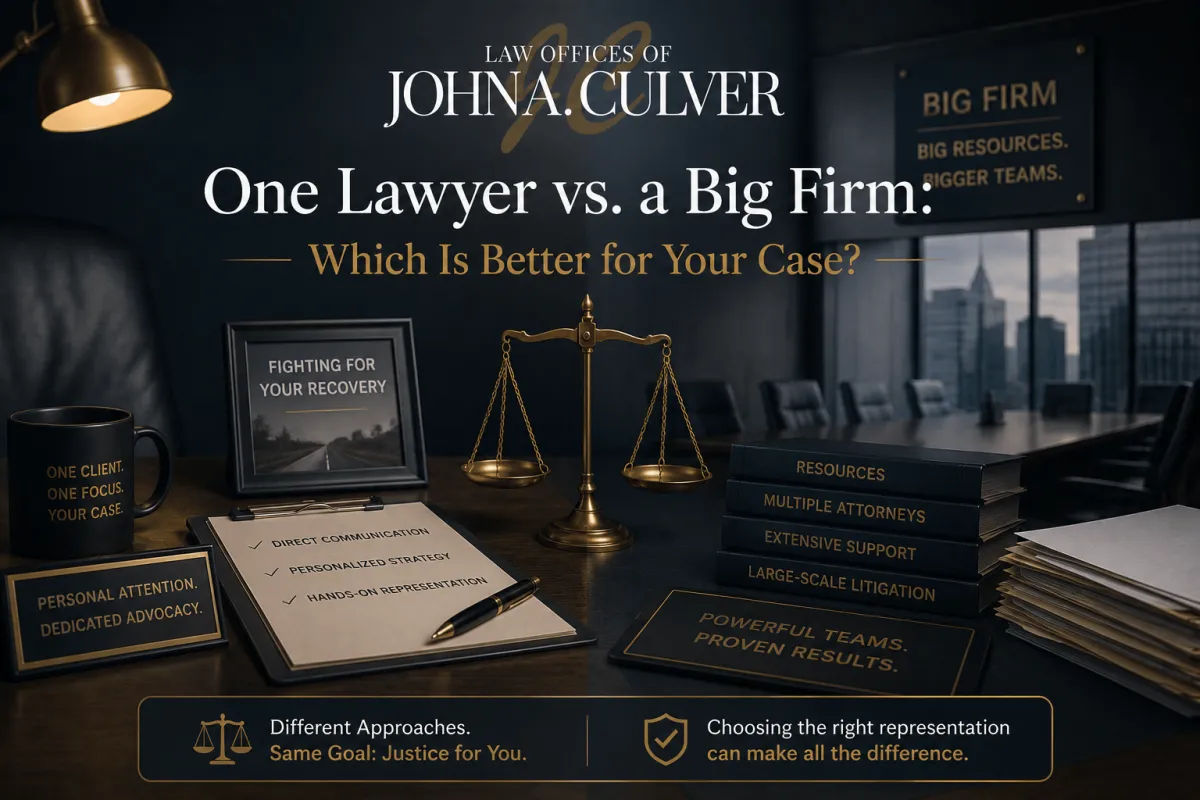
One Lawyer vs. a Big Firm: Which Is Better for Your Case?
The Attorney You Meet Is Not Always the Attorney on Your Case
When you search for a personal injury attorney in Chicago, you will encounter two fundamentally different types of practices. On one end are large firms — sometimes with dozens or hundreds of attorneys, multiple offices, and marketing budgets that produce constant advertising. On the other are solo practitioners and small practices where one named attorney handles your file personally from beginning to end. Both models can produce excellent results, but the experience of working with each is dramatically different. For many clients, that difference matters as much as the outcome itself.
How the Two Models Compare in Practice
The table below captures the most significant practical differences between a solo or small practice attorney and a large personal injury firm. These distinctions affect your day-to-day experience, your communication, and the attention your specific case receives throughout the process.
Why Many Chicago Clients Choose Solo or Small Practice Attorneys
For personal injury clients in Chicago, Illinois, one of the most meaningful guarantees of good representation is knowing that the attorney you spoke with at the consultation is actually working your file. With a solo or small practice, this is the standard — not the exception. You develop a direct relationship with one person who knows the facts of your case from the first phone call to the final resolution, returns calls personally, and has a genuine stake in your outcome.
Solo practitioners build their practices on community reputation. In Chicago, Illinois, where referrals and word-of-mouth drive a substantial portion of legal business, every case matters — not because it is policy, but because one bad outcome can echo through a career. That accountability produces a different quality of attention. It also produces deep local knowledge: an attorney who has handled personal injury cases in Chicago for decades knows the local courts, the judges who decide motions, and the patterns of specific insurers in ways that broader practices cannot replicate.
When a Large Firm May Have a Genuine Advantage
Large firms offer real advantages in certain situations, and they should not be dismissed. When a case involves catastrophic injuries with complex future damages, multiple corporate defendants, intricate product liability chains, or mass tort considerations, the in-house depth of a large firm — dedicated medical experts, full-time investigators, and specialized litigation teams — can provide meaningful support without the coordination delays of outside contractors.
Large firms also carry brand recognition that can affect early negotiation dynamics. A defense adjuster who recognizes a prominent plaintiff's firm on the opposing side may approach settlement differently than they would with an attorney they do not know. In Chicago, Illinois, where major insurers and corporate defendants frequently appear in personal injury cases, this reputational signal is not meaningless — though it is rarely the most important factor in determining what you ultimately recover.
The Questions That Matter Before You Hire Anyone
Regardless of firm size, the most important step you can take is asking direct questions during the consultation before you commit. These six questions will tell you what you actually need to know:
Who will handle my case on a day-to-day basis — you personally, an associate, or a paralegal?
How many active cases do you currently have open?
How will you communicate with me, how often, and what is the best way to reach you directly?
What is your specific experience with cases similar to mine — same type of accident, similar injuries?
Have you taken personal injury cases to jury verdict, or does your practice resolve exclusively through settlement?
What is your honest assessment of my case, its strengths, its weaknesses, and its realistic value?
An attorney who answers these questions directly and without hedging — whether they are a solo practitioner or a partner at a large firm — is demonstrating the transparency that good representation requires.
Frequently Asked Questions
Does the size of my attorney's firm affect how much I can recover?
Not directly. Settlement value is determined by the facts of your case — your injuries, your documented losses, and the strength of the liability evidence. What influences how much of that value you actually receive is the skill and commitment of the attorney working your case, which has no necessary relationship to firm size.
Are large firm attorneys more experienced than solo practitioners?
Not as a rule. A solo attorney with 35 years of personal injury experience in Chicago, Illinois courts may have far more relevant experience than a junior associate at a large firm who handles your file under supervision. Always ask about the specific attorney's experience, not the firm's general reputation.
What happens if my solo attorney becomes unavailable mid-case?
It is a fair question to ask upfront. Before hiring any solo practitioner, ask about their plan for covering your case if they become unavailable due to illness or other circumstances. A well-networked solo attorney will have referral relationships with trusted colleagues who can step in without disrupting your case.
Does advertising spending reflect legal quality?
No. Marketing investment reflects business strategy, not legal skill. Some of the most visible advertisers in Chicago, Illinois operate extremely high-volume practices with limited individual attention per client. Evaluate an attorney by their experience, their track record, and how they treat you in a consultation — not by how often you see their name on a billboard.
Can I change from a large firm to a solo attorney if I am unhappy?
Yes. You have the right to change representation at any point before your case concludes. Your new attorney handles the transition and works out the fee arrangement with the prior firm — this does not cost you anything additional. Your case continues under new representation without restarting.
Conclusion
The choice between a solo attorney and a large firm is ultimately a choice about the kind of legal relationship you want and the type of representation your case needs. For most personal injury clients in Chicago, Illinois, the direct access, personal accountability, and community-rooted commitment of a solo or small practice attorney is exactly what a serious case calls for. The Law Offices of John A. Culver offers more than 35 years of hands-on, personally delivered legal advocacy for injured clients throughout Chicago. If you want an attorney who knows your name, knows your case, and fights for your outcome directly — contact us today for a free consultation.
